
Cardboard vs sisal vs carpet: an honest scratcher comparison

Full disclosure: we’ve been making cardboard scratchers since 2021, so we have a favourite. But each material has real pros and cons — here’s the honest version.
Carpet: the one to skip
Carpet-covered scratchers feel soft and look tidy in photos. The problems: carpet loops can snag claws, the pile holds dust and smells, and — worst of all — it teaches your cat that carpet texture is for scratching. Don’t be surprised when the hallway rug pays the price.
Sisal: durable, with caveats
Sisal rope is genuinely tough — a well-made sisal post survives years, and cats who love a high vertical pull enjoy it. The caveats: rope strands fray and can split a claw as they loosen; the fibres hold odour over time; and a tall post has to be heavy to be stable — a wobbly post gets abandoned after one scare. If your cat is a dedicated vertical scratcher, buy sisal — just buy a very stable one.
Cardboard: what cats pick when nobody’s guiding them
Put cardboard packaging on the floor and watch what happens — most cats are on it within the hour. Corrugated board gives way slightly under the claw, which is exactly the resistance cats look for. It never snags or splits a claw, it doesn’t hold smells, and it stays warm, so the scratcher doubles as a bed.
The honest downside: cheap cardboard scratchers are terrible. Thin single-layer board shreds into confetti in a fortnight and leaves crumbs everywhere. That’s the version most people have tried — and judged the whole material by.
The fix is density
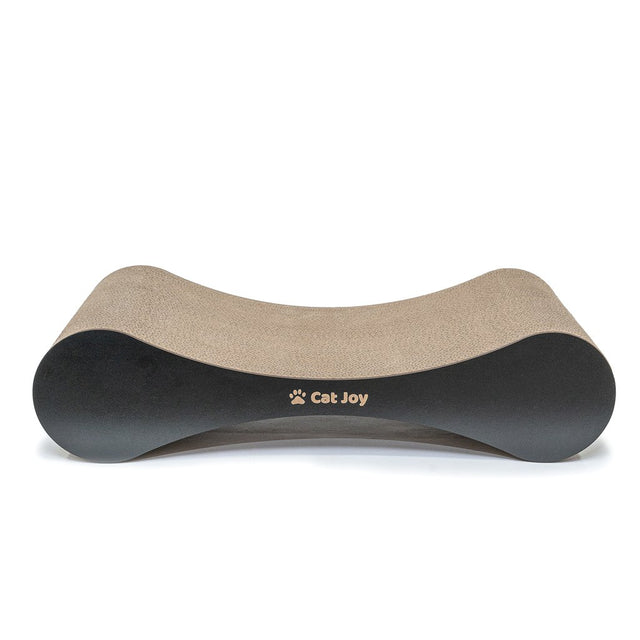
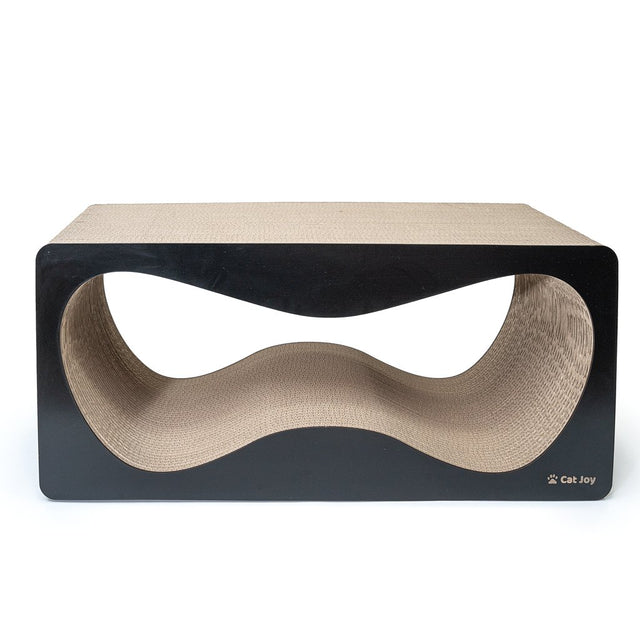
Our boards are 5-layer corrugated cardboard, pressed dense and framed with a wooden facade. That changes the economics completely: 12+ months with one cat, minimal crumbs, both faces scratchable — flip it when one side wears. We back it with a 1-year durability guarantee, which is not something you can offer on thin board.
Verdict: vertical devotee → heavy sisal post. Everyone else → dense cardboard, as long as it’s actually dense. See what 5-layer board looks like →
Our dense cardboard comes in eight sizes — from the compact Snug (59 cm) and the curved Lounge (70 cm) to the Terrace scratcher bed (77 cm) and the XL Penthouse house (85 cm).
