
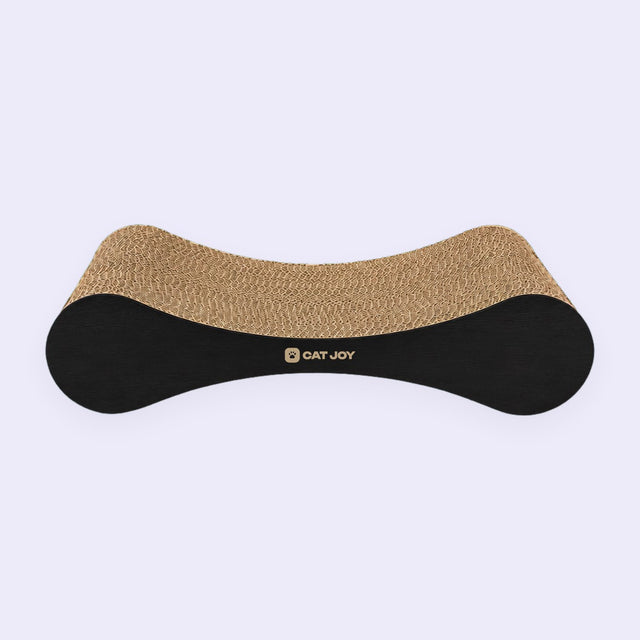
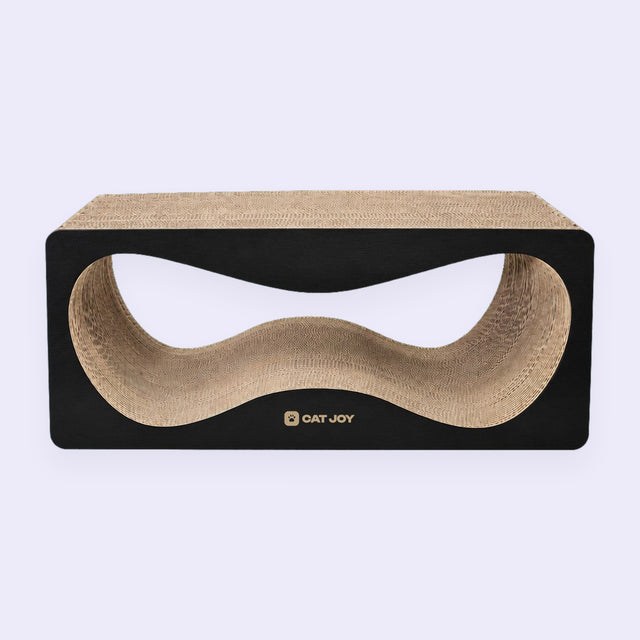
How CAT JOY scratchers are made: kraft corrugated cardboard, real wood and a 12-month guarantee

Every CAT JOY scratcher is made by hand in our own workshop in Peterborough, England. Dense 5-layer kraft corrugated cardboard is cut into layers, glued together with water-based glue and finished with real wood ends, and every scratcher is checked by hand before it leaves. That build is why we say it lasts 12+ months with one cat, and why we back it with a 12-month durability guarantee: falls apart? We replace it.
Why we make them by hand in England
CAT JOY started in 2021 with one cat, Alice, and a run of scratchers that crumbled, peeled or sagged within a few months. Alex has always worked with wood, so he built her a better one. We still make every scratcher the same way: by hand, in our own workshop. The full story is on our About us page.
Handwork takes longer, but it means a person looks at every stage: whether the layers have bonded, whether the wood ends sit firmly, whether the surface is even. And because the workshop is ours, each scratcher is made and dispatched from the same place.
The board: dense 5-layer kraft corrugated cardboard
Kraft corrugated cardboard looks plain, but it is built in layers. FEFCO, the European federation of corrugated board makers, describes it as flat outer layers called liners glued to a wavy inner layer called fluting. The waves form a series of connected arches, and that is what gives the board its rigidity. Add a second fluted sheet and a third liner and you have what the packaging trade calls double wall board: five layers in all, as the packaging maker DS Smith sets out.
Ours is that kind of board: dense kraft corrugated cardboard, 5 layers. The word kraft comes from the German for strength. In a scratcher, the board is cut into shaped layers and stacked side by side, so the surface your cat scratches is made of the cut edges of every layer, packed tight together.
Why does that matter to a cat? Cats Protection says cats prefer to scratch objects that are sturdy, so they can get a good grip and dig their claws in. Dense board gives the claw something to pull against: it gives a little, then holds. In our experience, thin or loosely packed board crushes under the claw, wears into a hollow and sheds far more. With dense board, expect a few crumbs in the first week and very few after that.
The wood ends: why real wood
Kraft corrugated cardboard is the part your cat scratches; wood is the part that keeps it in shape. Every CAT JOY scratcher has real wood ends, which we call facades, glued to the kraft corrugated cardboard block.
- They hold the block together. Solid sides stop the layers spreading and flaking at the edges when a strong cat digs in.
- They help it stay put. Cats Protection advises a heavy, stable base so a scratching post doesn’t wobble or topple, and International Cat Care warns that some scratching products are too lightweight and move around during use.
- They look like furniture. The facades come in brown, white or black, so the scratcher can sit in the living room instead of hiding in a corner.
- They can carry a name. Wood takes engraving, which is how a Bespoke scratcher gets your cat’s name on the facade.
How a scratcher comes together
Every model follows the same basic steps:
- Cut. The board is cut into layers in the outline of the model, and the wood ends are cut to match.
- Glue and stack. Layer by layer, the pieces are glued together with water-based glue into one solid block. Because the layers share the model’s outline, the block takes its shape: the gentle curve of the Lounge, the tunnel of the Terrace.
- Fit the wood ends. The facades are glued on, closing the block at both ends.
- Check by hand. Every scratcher is checked before it ships: layers bonded, edges clean, facades firm, surface even.
The finished scratcher is kraft corrugated cardboard, real wood and water-based glue, with no plastic. It arrives fully assembled, so there is nothing to build.
How long it lasts and what the guarantee covers
With one cat, a CAT JOY scratcher lasts 12+ months. Both faces are scratchable, so when one side wears, you flip it over and start again on a fresh surface. Two cats, a very heavy cat or a daily enthusiast will wear it faster; a cat who mostly naps on it will make it last longer. There is more on what affects lifespan in how long a kraft corrugated cardboard cat scratcher lasts.
Every scratcher also comes with our 12-month durability guarantee: falls apart? We replace it. It is a promise that the scratcher holds together.
- Covered: the kraft corrugated cardboard layers coming apart, a wood facade detaching, or the body breaking under the cats the model is made for.
- Not covered: normal wear of the scratching surface, chewing, and water, damp or outdoor use.
Claw marks, loose fibres and shallow grooves are not faults; they mean the scratcher is doing its job. Kraft corrugated cardboard is made for claws, not for teeth or wet floors, which is why those are left out. To make a claim, email meow@catjoy.uk with your order number and two or three photos. The full terms are in our FAQ.
How to make it last longer
- Flip it when one face starts to look tired.
- Turn it round every few weeks so the wear spreads more evenly.
- Keep it dry. Stand it away from damp floors and spills, and wipe the wood with a dry cloth rather than a wet one.
- Vacuum around it once a week to lift loose flakes.
- Give each cat their own. International Cat Care recommends one scratching post per cat, plus one extra for choice.
Every CAT JOY model is made the way described above, in eight sizes and three wood colours. For most adult cats up to 6 kg, the curved Lounge (70 cm) is a good place to start; for big breeds or two cats, the XL Penthouse (85 cm) adds a house and a flat bed. For something personal, Bespoke has your cat’s name engraved on the wood facade of any model. Compare them all in our scratchers collection.
Questions owners ask
How are kraft corrugated cardboard cat scratchers made?
A kraft corrugated cardboard scratcher is usually corrugated board cut into strips or shapes and glued into a block, so the cat scratches the cut edges. What varies is the board, what holds it together and how carefully it is put together. Ours are cut, glued and checked by hand, with real wood ends.
What is kraft corrugated cardboard?
Kraft corrugated cardboard is a dense, strong board; the name kraft comes from the German word for strength. Our scratching blocks are made from it.
Does the guarantee cover a worn scratching surface?
No. Wear is the scratcher doing its job. The guarantee covers the scratcher holding together: the layers, the facades and the body. When one face is worn, flip it to the other.
Is kraft corrugated cardboard as durable as sisal?
A well-made sisal post is very tough and suits cats who love a tall, upright pull. Kraft corrugated cardboard suits cats who scratch flat or at an angle, and dense board closes much of the gap in lifespan. We compare them in kraft corrugated cardboard vs sisal vs carpet.
