
Scratching posts for large cats and Maine Coons: what actually works

If you live with a Maine Coon, a Ragdoll, a Norwegian Forest Cat or simply a big British Shorthair, you already know the problem: the average cat scratching post is built for a 4 kg cat. Your cat grabs the top, pulls — and the whole thing tips over. After that they go back to the sofa, and who can blame them.
Why standard posts fail large cats
- Too short. A cat scratches to stretch the whole body. A large cat standing on their hind legs reaches well past the top of a typical post, so they can never get the full stretch they are after.
- Too light. A 7–9 kg cat pulling on a narrow pole with a small base is a lever. If it rocks even once, many cats will not come back to it.
- Too narrow to rest on. Big cats like to lie where they scratch. A small platform that leaves half the cat hanging off is not a bed.
The numbers: how big is big enough?
Use the rule of paw: the scratching surface should be at least as long as your cat from nose to base of tail. Measure your cat while they are stretched out asleep. For most large breeds that means a scratcher of roughly 70–85 cm, and wide enough for the cat to lie on with all four paws on board. If you are between two sizes, go up. There is a full table in our cat scratcher size guide.
Why horizontal scratchers suit big cats
A horizontal scratcher cannot tip over: the cat’s own weight holds it down, so the heavier the cat, the more stable it gets. That is the opposite of an upright post, where more weight means more wobble. A long, flat, dense cardboard scratcher also gives a large cat what they rarely get anywhere else — room to lie fully stretched out.
Look for:
- Length of 76 cm or more for cats over 7 kg.
- Dense, multi-layer cardboard. Thin single-layer pads flatten quickly under a heavy cat.
- Width. A narrow strip is a scratcher; a wide deck is a scratcher and a bed.
- Solid sides. A frame keeps the cardboard block together when a strong cat really digs in.
Two cats, one scratcher?
In a multi-cat home the ideal is one scratcher per cat in different rooms — cats like to have their own territory. If space only allows one, make it a genuinely wide XL model, or one with two levels so that both cats can use it at once without arguing.
Which CAT JOY models suit large cats
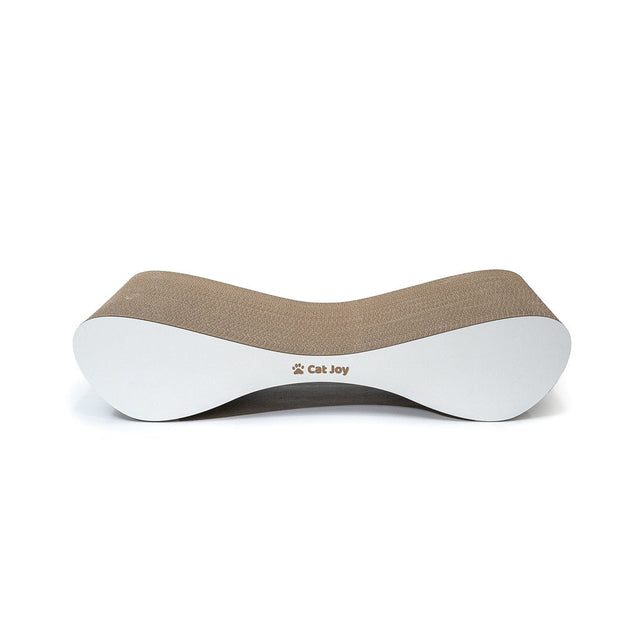
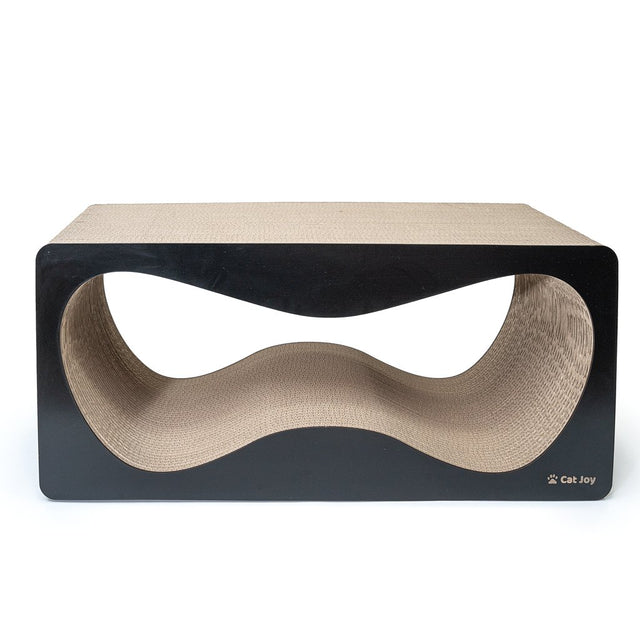
- Penthouse — our extra large cat scratcher house, 85 × 39 cm, with a flat top and a cave inside. Made for giant breeds and for two cats sharing — and, new this autumn on pre-order, the XL Manor and XXL Rotunda.
- Mews — a 76 cm two-level cardboard cat scratcher house with a hideaway underneath: one cat on top, one below.
- Terrace — 77 cm scratcher and bed in one, for bigger-than-average cats who are not quite Maine Coon size.
All three are handmade from dense 5-layer cardboard with a real wood facade, and come with free UK delivery and 30-day returns. See them together in large cat scratchers.
Where to put it
Next to where your cat sleeps, or beside the piece of furniture they currently scratch. Big cats are creatures of habit: make the new scratcher the easiest option within reach and the sofa loses. Our one-week plan is here: how to redirect a cat from the sofa.
