
Why cats scratch your sofa — and how to redirect them in a week

First, the reassuring truth: your cat isn’t punishing you. Scratching does three jobs at once — it sheds the outer layer of the claw, gives the back and shoulders a deep stretch, and leaves both a visible mark and a scent mark from glands in the paws. It’s as natural as sleeping.
Which means the goal is never to stop scratching — it’s to give your cat a better place to do it.
Why the sofa, specifically?
- It’s in the social centre of the home — territory worth marking.
- It’s stable — it never wobbles or slides.
- The fabric has the perfect resistance — it gives way slightly under the claw.
A good scratcher has to beat the sofa on all three points. Here’s the plan.
The one-week redirect
Days 1–2: placement is everything
Put the new scratcher right next to the scratched spot — touching the sofa arm if you can. Cats scratch where they already scratch; a scratcher hidden in the spare room doesn’t exist. Rub a pinch of catnip into the surface on day one.
Days 3–4: make the sofa boring
Cover the favourite corner with a throw blanket or double-sided tape — anything that changes the texture. Don’t shout or squirt water; fear just teaches cats to scratch when you’re out.
Days 5–7: reward the switch
Every time you see the scratcher being used — treat, praise, play. Cats repeat what pays. Most cats have fully switched within the week; kittens often within a day.
Keep it that way
Once the habit has moved, you can uncover the sofa. Leave the scratcher where it is for a few more weeks before slowly sliding it (a little each day) to its final spot. And if your cat ignores the new scratcher at first? Run through our 24-hour checklist — with cardboard it rarely comes to that: it’s the texture most cats choose on their own.
Which scratcher beats the sofa?
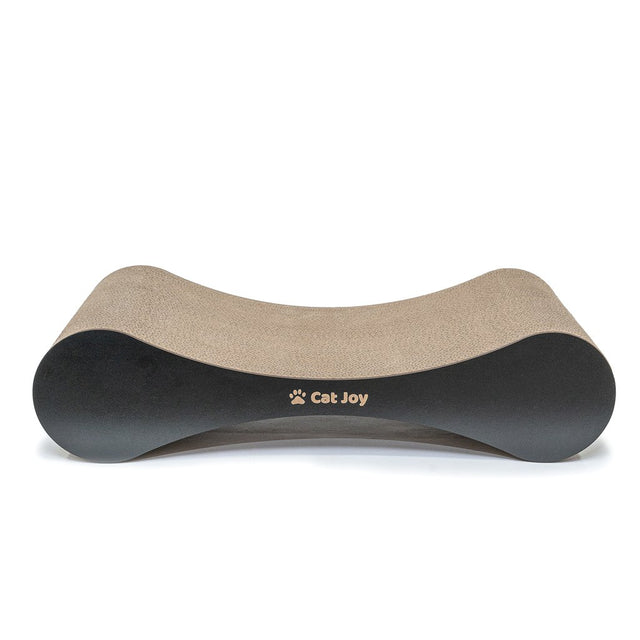
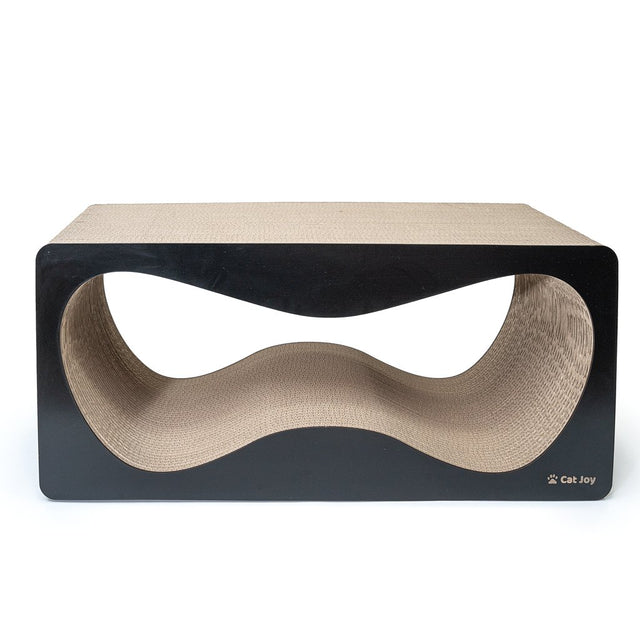
To win, the scratcher has to be as stable as the sofa and long enough for a full stretch. The Terrace (77 cm) is long and low enough for a full standing stretch; the compact Pavilion (68 cm) tunnel suits cats who like to scratch from a hideaway; and for big breeds the Penthouse (85 cm) stays put under a heavy cat — and, new this autumn on pre-order, the XL Manor and XXL Rotunda.
A low, horizontal cat scratch board right next to the sofa arm is often the quickest fix. Browse the eight sizes →
