
What size scratcher does your cat need? A simple rule that always works

Buy a scratcher that’s too small and your cat will use it — badly, briefly, with their back half hanging off. The stretch is the whole point, so size matters more than any other spec.
The rule of paw
The scratcher should be at least as long as your cat from nose to base of tail. That’s the length that lets them plant both front paws, arch the back and pull — the full movement. When you’re between sizes, go up: no cat has ever complained about a bigger bed.
By weight and life stage
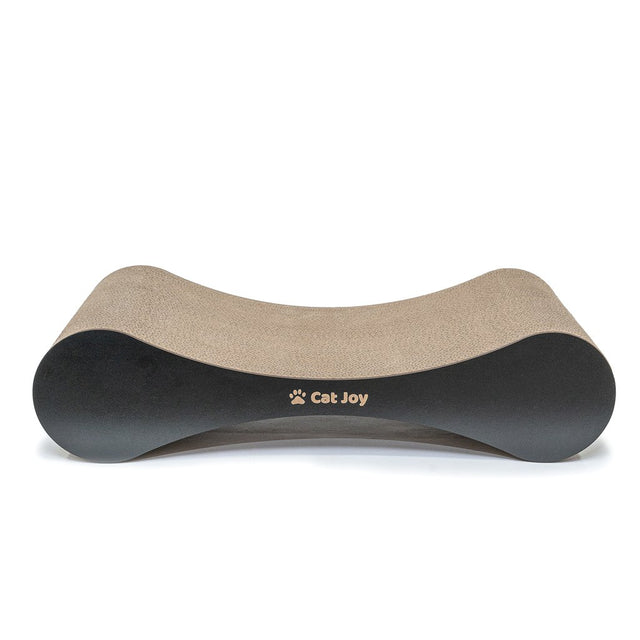
- Kittens and small cats (up to ~4 kg): a compact 59–70 cm scratcher fits under a windowsill or in a corner and is light enough to move around. Kittens grow into the bigger end fast — our Snug (59 cm) and Lounge (70 cm) cover this range. More in our kitten scratcher guide.
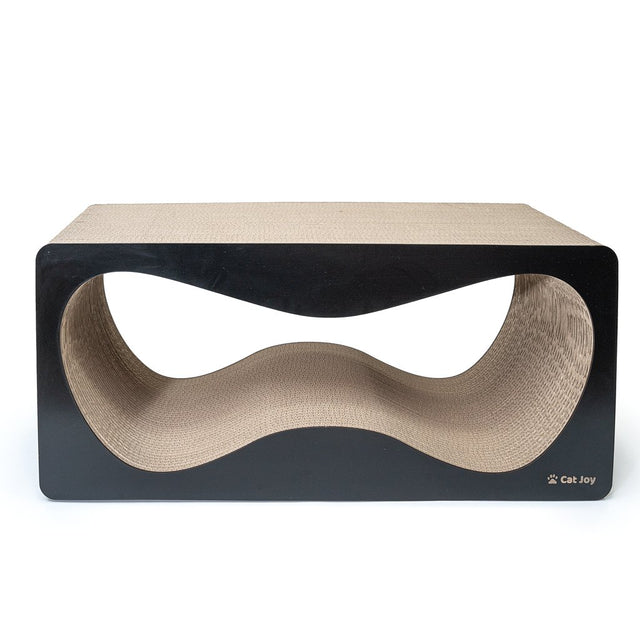
- Average adult cats (4–7 kg): 68–77 cm. A compact tunnel like the Pavilion (68 cm) suits cats who like a hideaway; the Terrace (77 cm) is scratcher and bed in one.
- Large breeds — Maine Coon, Ragdoll, British (7 kg+): think 70–85 cm minimum. A Maine Coon can be a metre long nose to tail; a small scratcher is furniture-scale comedy to them. The Mews (76 cm, two levels) and Penthouse (L 85 × D 29 × H 39 cm) are built for exactly this — and, new this autumn on pre-order, the XL Manor and XXL Rotunda.
- Two cats: either two scratchers in different rooms (ideal — cats like their own territory) or one genuinely wide XL they can share without arguments.
Don’t forget height and weight of the scratcher itself
A horizontal scratcher should be heavy and wide enough not to slide mid-scratch — dense 5-layer board provides that mass. A light, hollow scratcher that skids across the floor gets abandoned as fast as a wobbly post.
Still unsure between two models? The full size guide has a side-by-side table — or just message us with your cat’s weight and we’ll answer the same day.
