
Best cat scratching post? How to choose one your cat will actually use

Search for the best cat scratching post and you get hundreds of near-identical beige poles. The honest answer is that there is no single winner: the best cat scratcher is the one your cat uses every day instead of your sofa. Whether that happens comes down to five things you can check before you buy.
1. It must not move
This is the number one reason scratchers get ignored. A cat puts their whole body weight into a scratch. If the post wobbles or the pad skids across the floor, the cat learns in one go that it can’t be trusted — and goes back to the sofa, which never moves. Upright posts need a wide, heavy base. Horizontal scratchers need enough mass and width to stay put; the cat standing on it helps.
2. It must be long (or tall) enough for a full stretch
Scratching is a stretch as much as claw care. The rule of paw: the scratching surface should be at least as long as your cat from nose to base of tail. For an upright post that usually means around 80 cm or more for an adult cat — most budget posts are far shorter. For a horizontal scratcher it means 54–63 cm for kittens and small cats, 59–70 cm for the average adult and 77 cm or more for big breeds. There is more detail in what size scratcher does your cat need?
3. The material has to feel good under the claw
- Sisal rope or fabric — tough and long-lasting, the classic choice for upright posts.
- Corrugated cardboard — the texture many cats go for first. It gives slightly under the claw, holds warmth, and doubles as a bed. It wears down over time and is replaced rather than repaired.
- Carpet — best avoided. It teaches your cat that carpet is for scratching, and they will not tell your stair carpet from their post.
We compared all three in detail here: cardboard vs sisal vs carpet.
4. Match the way your cat scratches
Watch your cat for a day. Do they reach up the side of the sofa or the door frame? They are a vertical scratcher and need a tall post. Do they dig into rugs, doormats and the carpet at the top of the stairs? They are a horizontal scratcher, and a flat cat scratch board or lounger will suit them far better than any pole. Plenty of cats do both — see horizontal vs vertical scratchers.
5. It has to live where your cat lives
Cats scratch where they spend time: next to where they sleep, and in the room where the family sits. A scratcher hidden in the spare room because it is ugly will not get used. So looks matter more than they seem to — pick something you are happy to keep in the living room.
The main types at a glance
- Upright sisal post — good for vertical scratchers. Check height and base weight before anything else.
- Cardboard cat scratcher or lounger — good for horizontal scratchers and for cats who like to nap where they scratch. Look for dense, multi-layer board rather than a thin single-layer pad.
- Scratch mat — cheap and portable, but it slides unless you fix it down.
- Cat tree — climbing, sleeping and scratching in one, at the cost of a big footprint. The scratching sections are often short.
Where CAT JOY fits
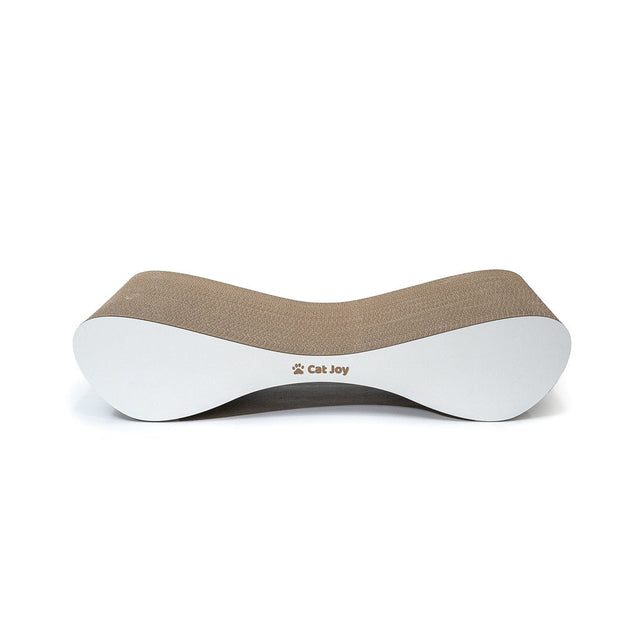
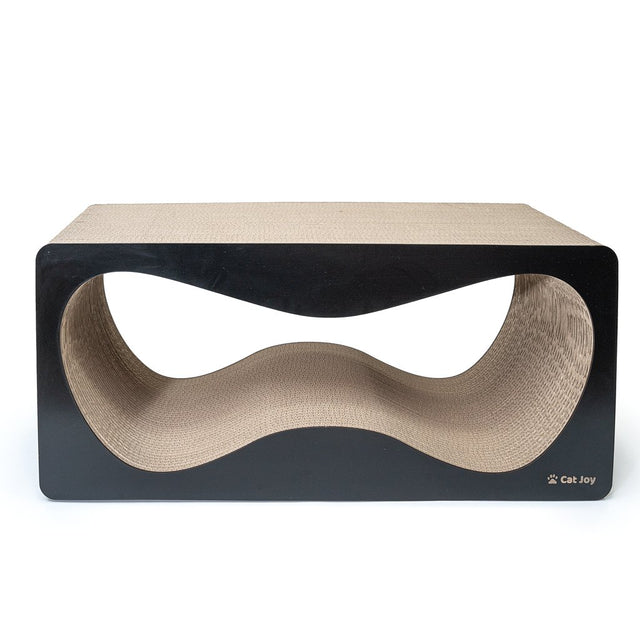
We make one type and try to make it properly: horizontal cardboard cat scratchers with a dense 5-layer core and a real wood facade, in six sizes from 54 to 84 cm. They are stable on the floor, long enough for a full stretch and finished to look like furniture. If your cat is a committed vertical scratcher, pair one with a tall sisal post — many homes need both.
Quick checklist before you buy
- Does it stay still when pushed hard?
- Is the scratching surface at least as long as your cat, nose to base of tail?
- Sisal or dense cardboard — not carpet?
- Does it match how your cat scratches now?
- Will you be happy to keep it in the living room?
Five yeses and you have found the best scratching post for your cat. Not sure about size? Try our three-question size finder.
