
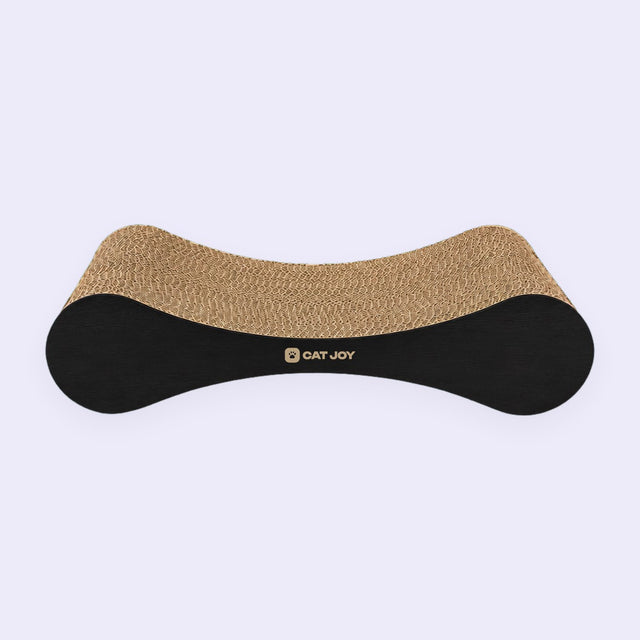

Scratchers for senior and arthritic cats: low, wide and easy on the joints

Yes, older cats still need to scratch — but stiff joints can turn a tall post into hard work. International Cat Care says horizontal scratching posts are easier for older cats to use than tall, vertical posts, which can place strain on arthritic joints. For most senior cats the answer is a low, wide, steady scratcher beside their bed, regular claw checks, and a chat with your vet if anything has changed.
Do older cats still need to scratch?
Scratching is not a kitten habit that fades. International Cat Care says a scratching post is still important for older cats who enjoy scratching: it exercises the front-leg muscles and can stop the nails thickening and overgrowing.
What changes is how easy it feels. As Cats Protection puts it, cats may still want to scratch but can find it difficult as they age. International Cat Care describes cats as “senior” between 11 and 14 years and “super senior” from 15.
Signs scratching has become uncomfortable
Cats are very good at hiding pain. Cats Protection says around 90% of cats aged over 12 will have some degree of arthritis detectable on X-rays, yet it often goes unnoticed because owners think their cat is just slowing down. Look for small changes:
- The old post is ignored. PDSA lists overgrown claws from using the scratching post less among the signs of arthritis.
- Claws that tap on hard floors or catch on the carpet.
- Thinking twice before a jump, or taking the stairs slowly.
- Stiffness after a nap that eases once they get moving.
- A scruffy back — grooming less, especially along the back and tail.
- Grumpier than usual when stroked or handled.
Cats Protection notes the signs can get worse in cold or damp weather. None of them proves your cat has arthritis — only a vet can tell you that — but two or three together are worth a check-up.
Why a low, horizontal scratcher is easier than a tall post
A tall post is built for scratching upright, standing on the back legs at full stretch. That is the kind of stretch International Cat Care warns can strain arthritic joints — the charity lists the shoulders, hips, elbows, knees, spine and ankles as the joints most commonly affected.
On a horizontal scratcher your cat keeps all four feet down and pulls back with the front legs, the way they would scratch a rug. Cats Protection suggests a horizontal scratching post, or one with a lower gradient, for older cats, and International Cat Care notes that senior cats may prefer large angled or horizontal kraft corrugated cardboard scratchers because they offer less resistance. If your cat still loves their tall post, keep it — more in horizontal vs vertical scratchers.
What to look for in a scratcher for an older cat
- A low step. Your cat should walk onto it, not jump. If jumping has become an effort, choose the lowest scratcher that is still long enough.
- Length for a gentle stretch — at least your cat’s length from nose to base of tail. Our simple size rule shows how to measure.
- A wide top with grip, so the whole paw lands on it. Dense kraft corrugated cardboard gives slightly under the claw.
- No wobble, no sliding. International Cat Care warns that lightweight scratchers can move around during use, and that laminate, tiled and wooden floors can be slippery for older cats. On a hard floor, stand it on a rug or non-slip mat.
- Somewhere to lie down. Older cats sleep for longer, so a scratcher that doubles as a shallow bed earns its place (see why cats sleep where they scratch). Keep a soft, well-padded bed close by too, as Cats Protection recommends.
Where to put it for an older cat
- Right next to their bed. Cats often scratch after sleep, so International Cat Care suggests placing the scratcher by their favourite bed.
- On the floor they live on. If your cat now avoids the stairs, International Cat Care advises keeping all their resources — food, water, beds, litter trays, scratching posts and toys — on that one level.
- Warm, draught-free and at floor level, so no jumping is needed.
- In the same place every day. Cats Protection notes that cats become even more creatures of habit as they age.
Introducing it? See how to get your cat using a new scratcher in 24 hours. Most cats are on it within a day; if yours needs persuading, message us at meow@catjoy.uk and we’ll help with placement.
Claws in older cats
International Cat Care explains that senior cats can struggle to retract their claws, so they catch in furniture and carpets, and that claws can overgrow, curl round and embed into the pads — painful, and a risk of infection if not treated. Cats Protection adds that claws can become thicker and longer with age, and advises checking them regularly.
- Ask before you trim. International Cat Care advises speaking to your vet first, because overgrown claws can sometimes point to a medical problem such as arthritis or hyperthyroidism. Your vet or vet nurse can trim them, or show you how to do it safely at home.
- If a claw has grown into the pad, PDSA advises calling your vet rather than sorting it out yourself.
- Expect a scratch afterwards. PDSA notes that cats want to sharpen their claws again after a trim — one more reason to keep a scratcher where they rest.
When to talk to your vet
International Cat Care advises contacting your veterinary team if your cat shows any signs of arthritis — even subtle changes can be important. A short phone video of your cat on the stairs helps, as cats may not show many signs at the clinic.
Arthritis can’t be cured, but Cats Protection says it can often be managed successfully, and your vet can talk you through pain relief made for cats. Never give your cat human painkillers: Cats Protection warns that even common anti-inflammatories such as ibuprofen can be highly toxic to cats. For most cats with arthritis, Cats Protection recommends a vet check-up every six months.
Low scratchers for older cats
Every CAT JOY scratcher is horizontal, made by hand in our Peterborough workshop from dense kraft corrugated cardboard with a real wood facade. For a stiff cat, start with the lowest: Snug (13 cm high, 59 cm long) for smaller cats up to 4 kg, or the curved Lounge (14 cm high, 70 cm long) for most adult cats up to 6 kg. For cats who still step up comfortably, Pavilion (20 cm, with a den underneath) suits small and older cats, and Terrace (21 cm high, 77 cm long) gives a big older cat a full-length stretch. Compare them in our scratcher collection.
Questions owners ask
Is it normal for an old cat to stop scratching?
Many older cats scratch less because it has become harder work. Mention it to your vet, as PDSA lists using the scratching post less as a sign of arthritis.
Why do my senior cat’s claws keep catching on the sofa?
Older cats can struggle to retract their claws, and it often means the claws are too long. Ask your vet or vet nurse to check and trim them, and give your cat an easy, low place to scratch.
Should I get rid of my cat’s tall scratching post?
Not if they still use it. Add a low horizontal scratcher where they sleep and let your cat choose.
Will a scratcher help my cat’s arthritis?
No scratcher treats arthritis — only your vet can advise on that. A low scratcher simply makes a normal, everyday behaviour easier, and International Cat Care notes that scratching is good exercise for the front-leg muscles.
