
Are kraft corrugated cardboard cat scratchers safe? Glue, mess, kittens and recycling

Yes — for most cats, a well-made kraft corrugated cardboard scratcher is a safe, natural thing to scratch. Kraft corrugated cardboard gives under the claw, there are no rope fibres to snag on, and a flat scratcher has nothing to tip over. What matters is what holds it together, what is on the surface, and whether your cat scratches it or eats it.
Is kraft corrugated cardboard safe for cats to scratch?
Scratching itself is nothing to worry about. Cats Protection describes it as a normal and instinctive behaviour that keeps the claws in good condition and leaves a scent message from glands between the paw pads. International Cat Care notes that kittens and senior cats may prefer large horizontal or angled kraft corrugated cardboard scratchers, because kraft corrugated cardboard offers less resistance and is easier to scratch.
You will see small flakes come away as your cat scratches. That is normal — the surface is doing its job, and it is part of why cats love kraft corrugated cardboard in the first place.
What about the glue?
A scratcher is dozens of strips of board glued into one block, so the glue is a fair question. What to look for:
- Water-based glue, stated plainly. If the listing doesn’t say, ask the maker.
- No strong chemical smell. New kraft corrugated cardboard and wood smell faintly of kraft corrugated cardboard and wood. A sharp, solvent-like smell is a reason to ask questions before your cat puts their nose in it.
- Plain board, no coatings. Avoid plastic films, glitter, paint or varnish on the surface your cat’s claws and face will be in every day.
- A frame that holds. Solid sides stop the layers spreading and flaking at the edges.
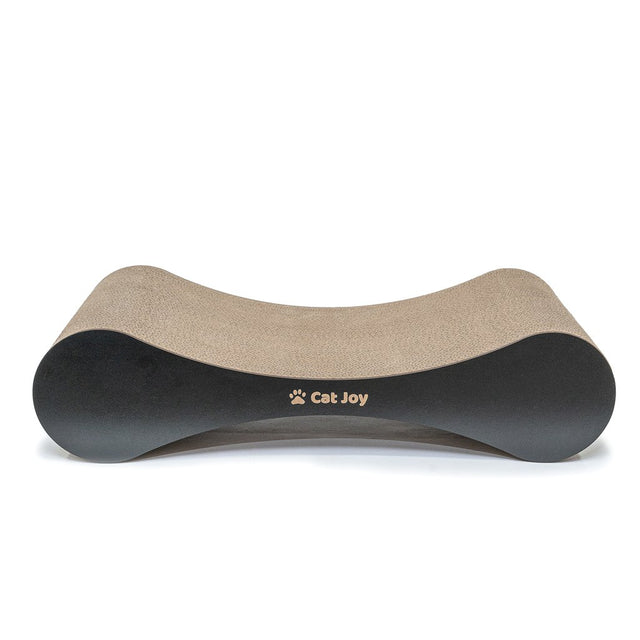
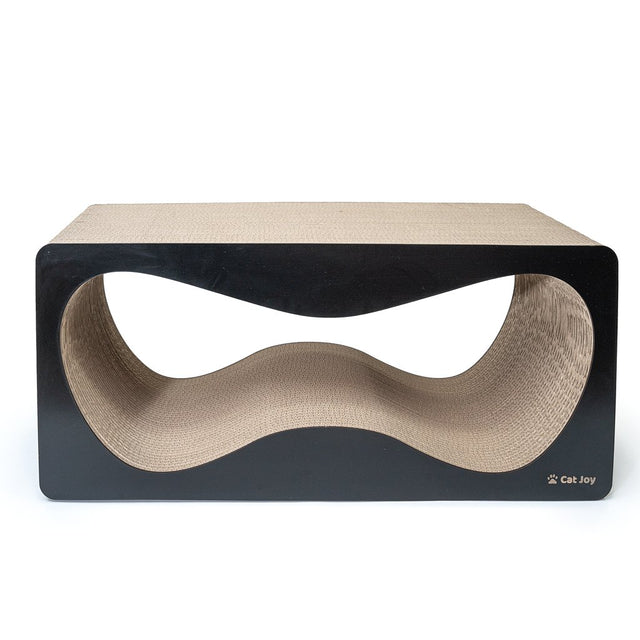
Every CAT JOY scratcher is made from dense 5-layer kraft corrugated cardboard and a real wood facade, held together with water-based glue — no plastic. Questions about our materials? Email meow@catjoy.uk or see our FAQ.
Kittens and cats who chew cardboard
Kittens explore with their mouths, especially while teething. Cats Protection explains that teething lasts until about seven months and that teething kittens may chew their toys or other objects around the house more than usual. Give a teething kitten something meant for chewing — Cats Protection suggests soft fabric toys rather than hard ones — and sweep up loose flakes so they don’t become a toy. Our kitten scratcher guide covers size and placement.
Scratching it is fine; eating it is different
Tearing off flakes while scratching is normal; regularly swallowing cardboard is not. International Cat Care calls eating non-food items pica and lists cardboard among the materials cats eat. It can have a medical cause, such as anaemia, or be linked to stress, boredom or frustration, and it is more common in Oriental breeds such as Siamese and Burmese. The worry is a blockage in the intestines, which can be life-threatening if left untreated.
If your cat eats cardboard rather than scratching it, speak to your vet. Meanwhile, International Cat Care suggests removing the things your cat eats, offering more play with moving toys such as a fishing-rod toy, and never punishing a cat for pica. If your cat has swallowed something they shouldn’t have, the PDSA advises contacting your vet straight away rather than waiting for symptoms.
Catnip and scratchers
A pinch of dried catnip rubbed into a new scratcher is the classic way to get a cat interested. Cats Protection says catnip is safe in small doses and believed to be non-addictive. Only around 70 to 80% of cats react to it, and kittens under six months typically don’t. If yours ignores it, play works just as well — see how to get your cat using a new scratcher in 24 hours.
Do kraft corrugated cardboard scratchers make a mess?
Some, yes — kraft corrugated cardboard that never shed a crumb would be kraft corrugated cardboard your cat couldn’t scratch. How much depends on the board: thin single-layer pads shred quickly, while dense multi-layer board held in by solid sides sheds far less. With a dense scratcher, expect a few crumbs in the first week, then much less. To keep it down:
- Stand it on a hard floor or a washable mat, so crumbs sweep up in seconds.
- Vacuum around it once a week.
- Flip it when one face wears, and turn it round every few weeks to spread the wear.
Weighing up other materials? We compare them in kraft corrugated cardboard vs sisal vs carpet.
How to clean a kraft corrugated cardboard scratcher
The one rule: no water. Damp kraft corrugated cardboard softens, swells and loses its shape, and the layers can start to come apart. Clean it dry:
- Give it a gentle shake over a bin, or outside, to drop loose flakes.
- Vacuum the surface with the brush attachment, along the grooves.
- Pick up cat hair with a lint roller or a dry rubber glove.
- Wipe the wooden sides with a dry cloth.
Don’t spray it with household cleaners or scent it with essential oils: Cats Protection lists both among the household items that can poison cats. If the kraft corrugated cardboard has been soaked by an accident or a spill, replace it. And if your cat has fleas, vacuum the scratcher along with their bedding — International Cat Care explains that flea eggs fall off into the home — and ask your vet about treating both your cat and your home.
When to replace it
A scratcher is meant to wear out. Replace yours when the favourite spot has worn into a deep hollow on both faces, the claws no longer catch, it has got damp or been chewed, or your cat starts going back to the sofa. Flip it to the second face first. With one cat, dense board typically lasts a year or more — more in how long a kraft corrugated cardboard scratcher lasts.
Recycling at the end of its life
A worn scratcher isn’t a delivery box. Recycle Now lists corrugated cardboard among the items that can be recycled, but not card that contains foodstuffs, dirt or paint — so shake out the hair and crumbs and keep it dry. It also says wood and timber aren’t accepted in household recycling but can be taken to most Recycling Centres.
A scratcher that combines the two — like ours, where the wood facade is glued to the kraft corrugated cardboard — probably won’t be accepted in your recycling bin as one piece. Rules differ between councils, so check first: Recycle Now’s Recycling Locator lets you enter your postcode to see what your council collects and find your nearest Recycling Centre. The box it arrives in? Let your cat enjoy it first, then recycle it as usual.
Every CAT JOY scratcher is handmade in our own workshop in Peterborough, England, with two scratchable faces and a 12-month durability guarantee — falls apart? We replace it. For a kitten or a cat up to 4 kg, the low Snug (59 cm) is an easy first scratcher; see all the kitten scratchers, or browse the full range.
Questions owners ask
Are kraft corrugated cardboard cat scratchers toxic?
Plain corrugated cardboard made with water-based glue, with no plastic coating or paint, is an everyday material for cats to scratch and lie on. Choose one with no strong chemical smell, from a maker who tells you what is in it. If your cat eats it rather than scratches it, speak to your vet.
Are kraft corrugated cardboard scratchers safe for kittens?
Yes, as long as your kitten scratches it rather than eats it. A low, flat one is easiest, and International Cat Care notes kittens may prefer kraft corrugated cardboard because it is easier to scratch. Size it for the adult your kitten will become.
Can I wash a kraft corrugated cardboard scratcher?
No. Water softens kraft corrugated cardboard and can make the layers come apart. Shake it out, vacuum it and wipe the wooden sides with a dry cloth.
