
How to stop your cat scratching the carpet (and the stairs)

If your cat drags their claws through the hallway carpet, the bottom stair or the doormat, you live with a cat who likes to scratch horizontally. That is good news: it is one of the easiest habits to move. You can’t stop a cat scratching — and you shouldn’t try — but you can give them something on the floor they like more than your carpet.
Why cats scratch the carpet
Scratching does three jobs at once. It keeps the claws in good condition by pulling away the worn outer layer. It stretches the legs, shoulders and back, which is why so many cats scratch straight after waking up. And it is a message: scent glands between the paw pads leave a smell on the surface, alongside the visible marks. The UK charity Cats Protection is clear that cats don’t scratch to be naughty or to get back at their owners.
So why the carpet in particular?
- It is the right angle. Some cats simply prefer to scratch standing on all fours rather than reaching up. International Cat Care notes that kittens and older cats often prefer large horizontal or angled cardboard scratchers.
- It grips back. Loop-pile carpets and coir doormats catch the claw and give a satisfying pull.
- It is in the right place. Hallways, doorways and the foot of the stairs are on your cat’s daily route — prime spots to leave a mark that says “I live here”.
- It is always there. If the only scratching surface in the home is a short post in a corner, the carpet wins by default.
Why the stairs?
Stairs are long, stable and never wobble, and the bottom step or the landing sits right on your cat’s route through the house. Many cats scratch there after waking up upstairs, or in a burst of excitement when you come home. The fix is the same as for carpet — a better surface in the same spot — with one safety rule: don’t put a scratcher on the steps, where it could slide or trip someone. Put it at the foot of the stairs or on the landing instead.
First, a quick check
Cats can scratch more when they feel stressed. If the scratching has started suddenly or spread to lots of places, think about what has changed — a new cat in the home or outside the window, building work, a house move. Cats Protection advises a health check with your vet to rule out any medical reason, and if your cat is also hiding, spraying or over-grooming, speak to your vet before anything else.
The one-week carpet plan
Day 1: put a scratcher on the exact spot
Not in the corner of the room — on the damaged patch itself, or right beside it. Cats go back to where they already scratch. Choose a horizontal scratcher at least as long as your cat from nose to base of tail, so they can stretch out fully (our size rule explains how to measure).
Days 1–3: make the carpet boring
Cover the favourite patch so it no longer feels the same under the claws: a heavy rug or runner, a thick blanket, or a pet-safe sticky sheet. Patch-test anything sticky on a hidden corner first so it doesn’t mark the carpet.
Days 2–5: make the scratcher irresistible
- Rub a pinch of catnip into the surface (not every cat reacts, and young kittens often don’t yet).
- Drag a wand toy across the scratcher so the paws land on it mid-chase.
- Praise or treat your cat the moment they use it.
Days 5–7: let the habit settle
Once your cat is scratching the new surface every day, uncover the carpet a little at a time. If the scratcher needs to live somewhere else, move it gradually — a few centimetres a day — rather than all at once. The full first-day checklist is in how to get your cat using a new scratcher in 24 hours.
What not to do
- Don’t punish. Shouting or a squirt of water doesn’t stop scratching; it makes your cat anxious and teaches them to scratch when you’re out.
- Don’t hold their paws on the scratcher. Cats find it off-putting and may avoid the scratcher afterwards.
- Don’t give them a piece of carpet to scratch. You will sometimes see an offcut suggested, but a carpet-covered scratcher teaches your cat that carpet is fair game. Corrugated cardboard gives the same flat, satisfying pull — here is how cardboard, sisal and carpet compare.
- Never consider declawing. Removing a cat’s claws for anything other than medical treatment is against the law in the UK — in England and Wales under section 5 of the Animal Welfare Act 2006, with equivalent laws in Scotland and Northern Ireland.
What makes a good carpet-replacement scratcher
- Flat or gently curved, so your cat can scratch standing on all fours, the way they scratch the carpet.
- Long enough for a full stretch — at least your cat’s body length.
- Heavy and stable, so it doesn’t skid on a hard floor or creep across the carpet mid-scratch.
- Dense cardboard that keeps its shape — thin single-layer pads flatten within weeks. (More in how long a cardboard scratcher lasts.)
- Worth lying on. Cats like to sleep where they scratch, so a scratcher that doubles as a bed gets used every day.
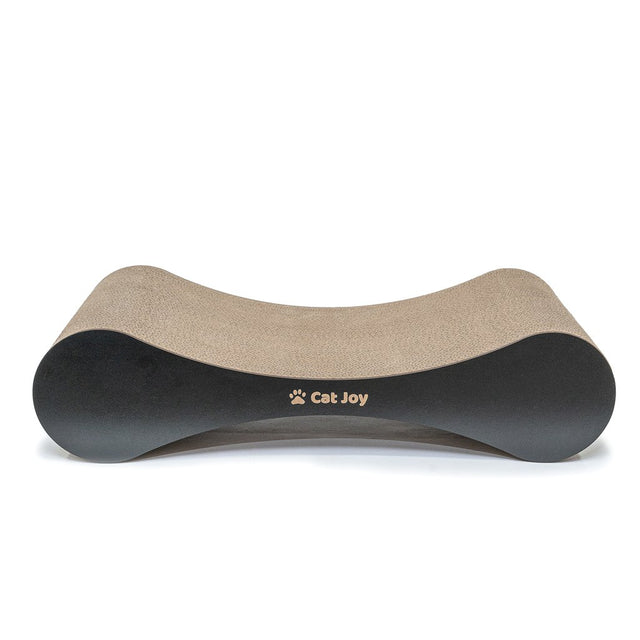
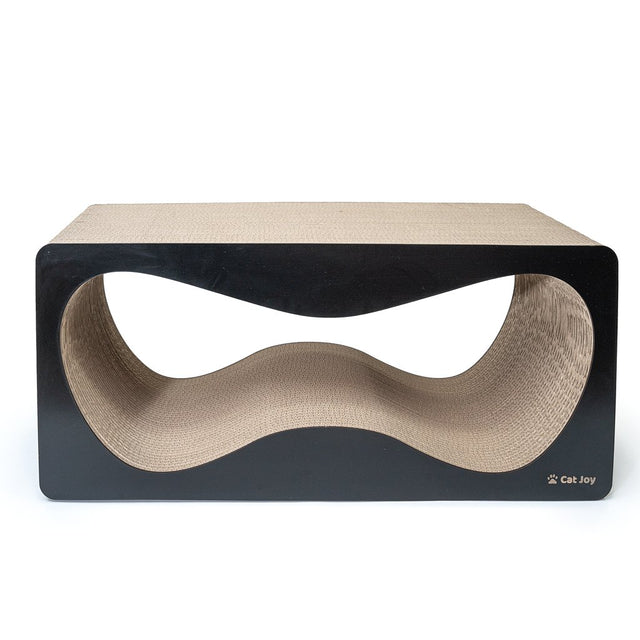
Every CAT JOY scratcher is horizontal by design, made by hand in our Peterborough workshop from dense corrugated cardboard with a real wood facade. For a kitten or small cat, the compact Snug (59 cm) fits neatly in a hallway. For most adult cats, the curved Lounge (70 cm) works at the foot of the stairs or by the sofa. For larger cats, the long, low Terrace (77 cm) gives a full stretch. See all the flat and low options in cat scratch boards and mats.
Questions owners ask
Why does my cat scratch the carpet by the door?
Doorways are borders. Your cat is marking the edge of their territory — often when you come home, or when they see another cat outside. Put a scratcher right by the door. If it comes with other signs of stress, read the quick check above.
Will my cat grow out of scratching the carpet?
No. Scratching is a lifelong need, not a kitten phase. What can change is where your cat chooses to do it — which is why it pays to set up a good scratcher early (see our kitten scratcher guide).
Will a tall scratching post stop carpet scratching?
Usually not on its own. A cat who scratches the carpet is telling you they like a horizontal surface. Plenty of cats enjoy both — more in horizontal vs vertical scratchers.
How many scratchers do I need?
International Cat Care recommends at least one scratching post per cat, plus one extra, in different places. For one cat that means two: one where they sleep and one at the spot they scratch now.
