
Why are some cat scratchers £8 and others £80? What you actually pay for

A basic cardboard scratch pad from a big pet retailer costs around £8. A large scratcher bed or lounger can cost £60–£130. Both give your cat something to scratch; the difference is mostly size, density and how long it lasts. Once you divide the price by the months your cat actually uses it, the gap is often smaller than it looks.
The short answer
Three things drive the price of a scratcher:
- Size. A bigger scratcher uses more material and gives your cat room for a full stretch.
- Density and weight. Tightly packed board resists the claw for longer, and a heavier scratcher stays put. International Cat Care warns that some scratching products are too lightweight: they don’t give enough resistance and can move around during use.
- How long it lasts. A scratcher that lasts a year can cost less per month than a pad you keep replacing.
What you get for around £8
At the bottom of the range are small corrugated cardboard pads and shallow loungers. On the UK pet retailers’ sites we checked, typical ones cost £5–£10 and measure roughly 40–55 cm across. They are cheap to try and easy to move. Where they fall short:
- Length. Measure your cat from nose to base of tail. If they are longer than the pad, they can’t stretch out on it fully (more in what size scratcher your cat needs).
- Weight. A light pad can skid across a hard floor mid-scratch, exactly the problem International Cat Care describes.
- Wear. Cheap pads rarely state a lifespan, and owner reviews vary widely: some pads are replaced every few weeks, others last a few months, and the odd one is “still going strong” after almost two years.
What you get for £60–£100+
Between the two sits a wide middle: larger mass-made cardboard loungers, mostly £15–£60. At the top end, roughly £60 to £130, you are usually paying for some of these:
- A full-length surface that a large adult cat can stretch out on.
- Weight and stability, so it doesn’t skid, tip or creep across the floor.
- Tougher material: denser multi-layer cardboard, or sisal and wood on upright posts.
- A bed as well as a scratcher. Cats Protection notes that cats often scratch and stretch when they wake up, so a scratcher that doubles as a bed is right where they need it.
- Looks and a guarantee: a finish you are happy to leave in the living room, and sometimes a year’s cover from the maker.
A high price is not a promise in itself; the same checks apply at £100 as at £8. Our guide to choosing the best scratching post has the full checklist.
Cost per month of use
The fairest way to compare scratchers is simple: price ÷ months of use.
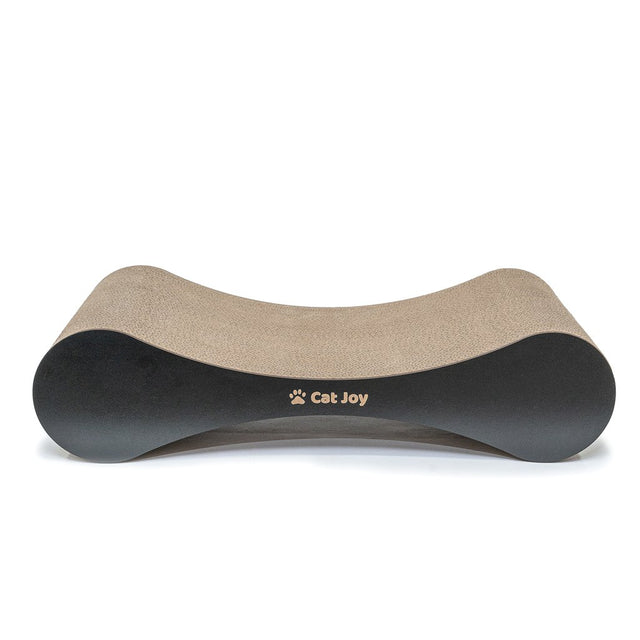
- A £43.95 lounger that lasts a year works out at under £4 a month. We say our scratchers last 12+ months with one cat, so that is the figure for our Lounge; the compact £34.95 Snug comes in under £3 a month.
- An £8 pad depends on how often you replace it: £4 a month if it lasts two months, £8 if it lasts one, about £1.33 if it lasts six.
So a cheap pad isn’t automatically the cheaper option, and an expensive one isn’t automatically better value. Two cats sharing will wear any scratcher faster, while flipping a two-sided board when one face wears stretches the months further. More in how long a cardboard scratcher lasts.
Where the money goes in a handmade scratcher
What goes into the price of ours:
- Dense 5-layer corrugated cardboard, sheet after sheet glued tight, so the claw meets firm resistance and crumbs stay in the board rather than on your floor.
- More of it. A 70 cm lounger simply uses far more board than a 40 cm pad.
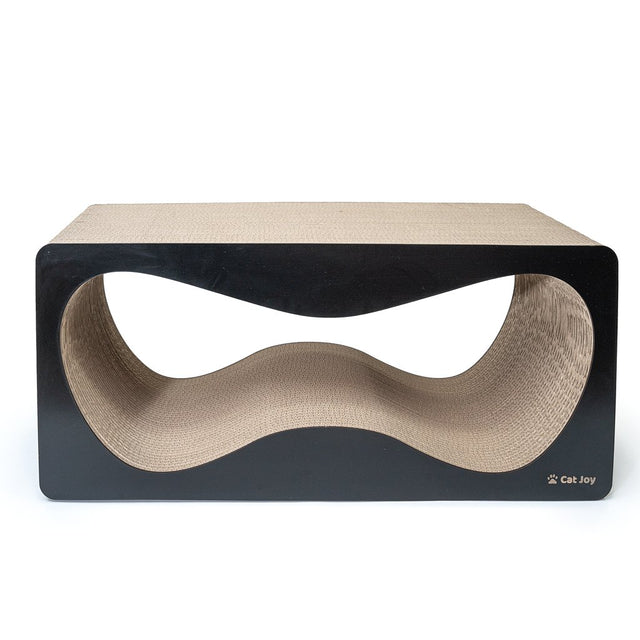
- A real wood facade in brown, white or black that makes the scratcher look like furniture.
- Hand assembly in England. Every piece is cut, glued and checked by hand in our own workshop in Peterborough, with water-based glue and no plastic. Handwork is slower than a production line, and that time is in the price.
- A 12-month durability guarantee. Falls apart? We replace it. It covers structural failure, not normal wear of the scratching surface; scratch marks just mean it is doing its job.
The cardboard isn’t off the shelf: it is kraft corrugated board, made to order for us to our own specification. The real wood ends do more than look good, too: they hold the layers together, so the edges don’t spread or flake when a strong cat digs in.
When a cheap one is the right choice
- Testing what your cat likes. Not sure whether your cat prefers to scratch flat or upright? A pad on the floor is a low-cost way to find out.
- A kitten’s first months. A small pad is fine as a starter. When you buy the scratcher you mean to keep, size it for the adult your kitten will become, as our kitten scratcher guide explains.
- A spare for another room. International Cat Care recommends one scratching post per cat, plus one extra for choice. A cheap pad by the front door can be that extra, while a sturdier scratcher sits where your cat sleeps.
Where cheap is usually the wrong saving: a big cat, a cat who scratches hard every day, or a scratcher that has to stay put on a smooth floor.
How to spot a good deal in the Black Friday sales
Black Friday is on 27 November this year. Before you click:
- Measure your cat first. The scratching surface should be at least as long as your cat from nose to base of tail; check the surface, not the box. Our size guide shows how.
- Check the “was” price. Consumer group Which? tracked 175 home, tech and health products for a year around Black Friday 2024 and found 83% were the same price or cheaper at least once outside the sales period. Price-history sites can show whether a deal is real.
- Look for dimensions, weight and material. If a listing won’t say, be wary.
- Compare per month, not per box. Several short pads in a multipack don’t add up to one surface your cat can stretch out on.
- Check who sells and ships it. Which? advises checking the seller and being wary of any deal that looks too good to be true. Read the returns policy before you buy.
A scratcher your cat uses every day is a good buy at any time of year. One that slides into a corner and gets ignored is expensive at any price.
If you want a longer-lasting scratcher, every CAT JOY model is handmade in our Peterborough workshop from dense 5-layer cardboard with a real wood facade. The compact Snug (59 cm) suits kittens and cats up to 4 kg, the curved Lounge (70 cm) most adult cats up to 6 kg, and the XL Penthouse (85 cm) big breeds or two cats. Compare every size in our scratchers collection.
Questions owners ask
Why are cardboard cat scratchers so expensive?
Most aren’t: basic pads cost around £8. The ones that cost more are usually bigger, heavier and denser, and some are made by hand. Judge them on price per month of use.
Are cheap cat scratchers worth it?
Yes, as a test, a kitten’s starter or a spare in a second spot. As the main scratcher, a short, light pad you keep replacing can cost more over a year than one sturdy scratcher.
How often should I replace a cardboard scratcher?
When the favourite spot has hollowed out, the surface has gone smooth, or your cat starts going back to the sofa. If the board has two scratchable faces, flip it first.
Is cardboard better value than sisal?
They suit different cats. Cardboard suits cats who scratch flat or at an angle; sisal is most often used on upright posts. See our comparison of cardboard, sisal and carpet.
