
Do cats need a scratching post? What UK cat experts say

Short answer: yes. Every cat needs somewhere to scratch, every day, for their whole life. The real question is not whether your cat will scratch, but what — and if you don’t choose for them, they will choose the sofa, the carpet or the door frame. Here is what scratching is for, how many scratchers a cat really needs and where to put them, based on advice from UK cat welfare charities.
What scratching does for a cat
- Claw care. Scratching pulls away the worn outer layer of the claw and keeps the claws in good condition. The little crescent-shaped husks you sometimes find on the floor are exactly that.
- Stretching. A good scratch stretches the legs, shoulders and spine — which is why most cats scratch just after waking up.
- Communication. Scent glands between the paw pads leave a smell on the surface, and the scratch marks are a visible sign too. Cats Protection describes scratching as a way for cats to communicate with other cats and leave a reminder for themselves.
- Feeling at home. Cats can scratch more when they are stressed, and a familiar scratching spot that smells of them is reassuring.
None of this is bad behaviour. Cats don’t scratch the furniture to be naughty or to get revenge — they scratch it because nothing better was on offer.
Do indoor cats need a scratching post?
Indoor cats need one most of all. They have no trees or fence posts, so every single scratch happens on something in your home. A scratcher in the room where they spend the day — usually the living room — is the most useful thing you can buy an indoor cat.
What about cats that go outside?
Outdoor cats scratch trees and fences, but most still scratch indoors too — especially near doors, windows and their favourite sleeping spots, where marking matters to them. A scratcher by the back door or the cat flap is often all it takes to save the door frame.
Kittens and older cats
Kittens start scratching almost as soon as they are steady on their feet, and the habits they form early tend to stick — see our kitten scratcher guide. Older cats still need to scratch, but stiff joints can make reaching up a tall post harder. International Cat Care notes that kittens and senior cats may prefer large horizontal or angled cardboard scratchers, which take less effort. If an older cat is scratching less than before, ask your vet to check their claws at the next visit.
How many scratching posts does a cat need?
International Cat Care recommends providing every key resource — scratching posts included — at a minimum of one per cat, plus one extra, in different places. In practice:
- One cat: two scratchers — one near where they sleep, one in the main living area or at the spot they already scratch.
- Two cats: three, in different rooms, so neither cat has to share or wait. Cats Protection advises that every cat in a multi-cat home should have their own scratching post, placed apart to avoid conflict.
- More cats: keep adding one per cat, and mix vertical posts with horizontal scratchers so each cat can choose.
Where to put a scratching post
- Next to where your cat sleeps — cats often scratch and stretch as soon as they wake up.
- Where the family spends the evening. Scratching is partly a display; a scratcher in the spare room rarely gets used.
- On the spot they scratch now — right beside the sofa arm, on the worn patch of carpet or at the foot of the stairs (more in how to stop your cat scratching the carpet).
- By doors and windows, if that is where your cat leaves their mark.
What makes a good scratching post
- Big enough for a full stretch. Cats Protection says a post should be tall enough for your cat to scratch at full stretch; a horizontal scratcher should be at least as long as your cat from nose to base of tail. Our size guide turns that into centimetres.
- Stable. A post that wobbles once can be avoided for good. Heavy, wide bases — or low scratchers that simply can’t tip over — win.
- The right texture. Cats like a surface that gives slightly under the claw. Sisal and corrugated cardboard both work; carpet-covered posts blur the line with your floor. See cardboard vs sisal vs carpet.
- The right direction. Some cats reach up, some scratch flat on the floor, many do both. Watch what your cat does, then read horizontal vs vertical scratchers.
Can’t I just trim their claws instead?
Trimming the tips can help if your vet recommends it, but it doesn’t replace scratching — the stretch and the scent marking still need an outlet. And declawing is not an option: removing a cat’s claws other than for medical treatment is against the law across the UK — in England and Wales under section 5 of the Animal Welfare Act 2006, with equivalent laws in Scotland and Northern Ireland.
Our take
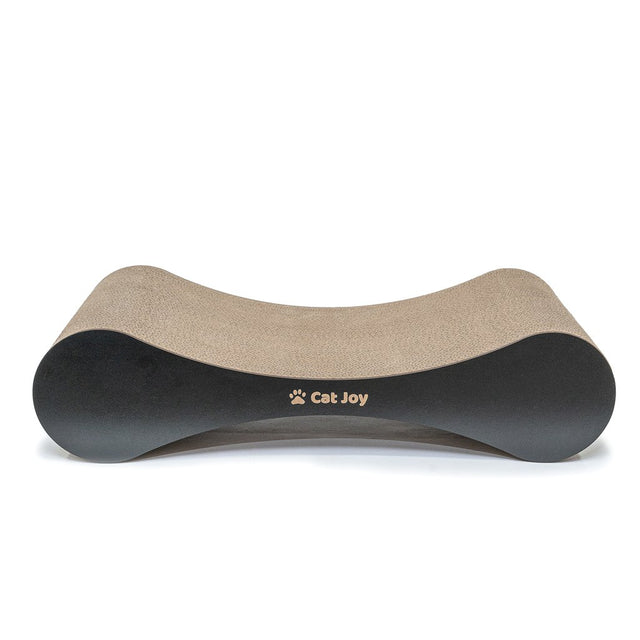
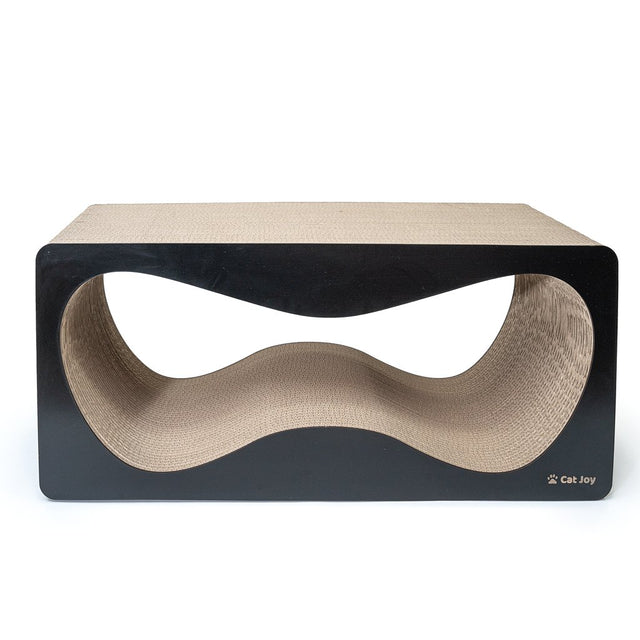
We make cardboard scratchers, so we are biased — but the honest summary is simple: give every cat at least one scratcher they love, in the room where they live, big enough for a full stretch. Every CAT JOY is a horizontal scratcher, lounger and bed in one, made by hand in our Peterborough workshop from dense corrugated cardboard with a real wood facade: the compact Snug (59 cm) for kittens, the curved Lounge (70 cm) for most adult cats, and larger sizes up to 85 cm for big breeds and two-cat homes. See all eight sizes, or answer three questions in our size finder.
Questions owners ask
What are scratching posts for?
They give your cat a place to do what they need to do anyway — look after their claws, stretch and leave their scent — so they don’t do it on your furniture.
Is a cardboard box enough?
Cats love boxes, and a box is better than nothing for a day or two, but thin delivery board shreds and collapses quickly. Here is why cats love cardboard boxes — and what lasts longer.
My cat ignores the scratching post. What now?
Usually it is in the wrong place, too short or too wobbly. Move it next to where your cat sleeps or already scratches, and follow our 24-hour checklist.
Will a scratching post save my sofa?
In most homes, yes — if it stands right next to the sofa and the sofa is made less appealing for a week. The full plan is in why cats scratch your sofa.
